


Find answers to the most frequently asked questions about ordering, using, and maintaining compressed air systems, compressors, and accessories.
For many compressed air applications, the quality of the compressed air is very important. The main substances that can be filtered from compressed air are moisture, particles, and oil. Compressed air quality is expressed according to its ISO standard. We advise you to ask the supplier of specific compressed air consumers which compressed air quality standard according to ISO 8573-2010 must be met:
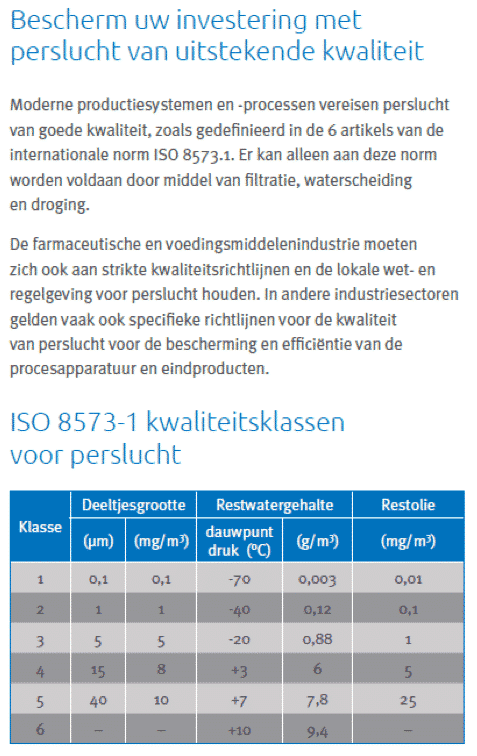
We remove moisture using a compressed air refrigerant dryer. Click here for more information about compressed air dryers.
Particles are small particles that can be harmful to various compressed air consumers because they often collide with the inside of walls at high speed.
Particle filters, also known as pre-filters, with a rating of 1 micron, must therefore be installed before a compressed air refrigerant dryer. This protects the refrigerant dryer and prevents malfunctions. Particle filters also serve to protect subsequent filtration and are therefore also mandatory prior to an oil filter.
Oil enters the compressed air from the compressor. A screw compressor is oil-lubricated and, despite the high filtration in the compressor’s separator filter, a small oil residue of ± 4 mg/m³ always remains in the compressed air.
An oil filter can remove this oil residue from the compressed air down to 0.01 mg/m³.
If this is still not sufficient removal, you can also opt for an activated carbon filter after the oil filter to remove the final oil vapors down to 0.003 mg/m³, which is technically oil-free compressed air according to ISO 8573-2010 oil class 1.
The filter elements have sufficient capacity to provide you with clean compressed air for a full year (8,000 operating hours or annually), so you will only need to perform maintenance on these filters once a year.
Hulp Nodig? Chat Met Ons!